Architecture note
When Data Manages the Application
When data evolves, application behavior evolves with it.
Applications built on fixed assumptions
Traditional applications are usually built around predefined assumptions.
A product is a product. A workflow is known in advance. Screens and logic are fixed at design time.
This approach works until reality changes — and it always does.
Processes evolve, responsibilities shift, and the same entity begins to require different behavior
at different moments in its lifecycle.
When data drives behavior
In a data-managed application, the application itself is an execution engine.
Behavior, UI, and workflows are derived from data definitions rather than hard-coded rules.
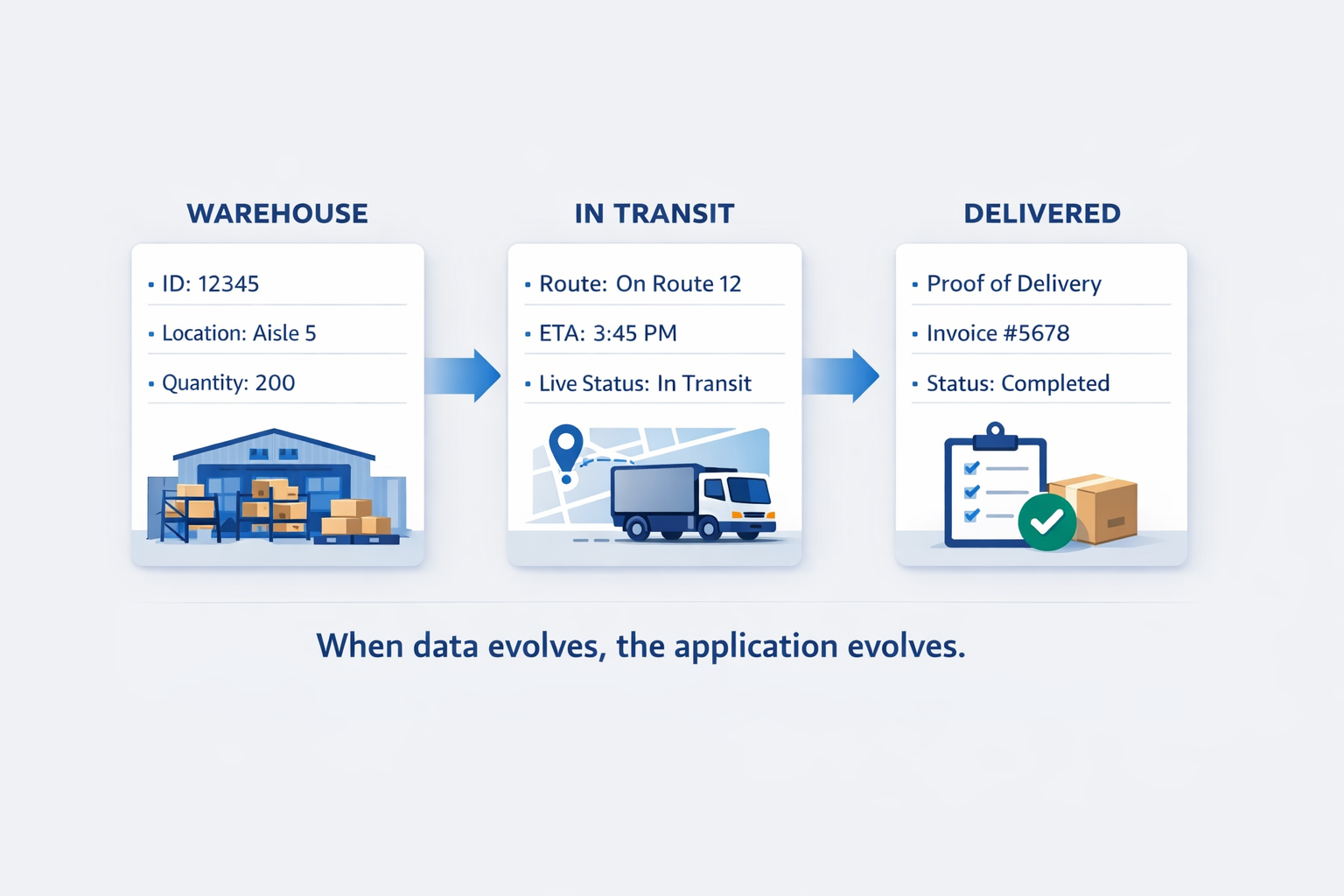
Consider a simple example: a product in a warehouse.
- Identifier
- Location
- Quantity
At this stage, the application focuses on inventory views, availability, and storage.
Nothing more is required.
Status change: In transit
When the product enters transit, the data model expands naturally.
- Carrier and route
- Estimated arrival time
- Live status or tracking events
The application evolves without redeployment.
New views appear, tracking becomes relevant, and notifications emerge —
simply because the data now represents a different state of reality.
Status change: Delivered
Once delivered, transit-related data becomes historical and new data takes precedence.
- Proof of delivery
- Invoice reference
- Completion status
Again, application behavior shifts automatically, driven by data rather than conditional logic
scattered across the codebase.
Why this matters
The key advantage of data-managed applications is not flexibility alone.
It is resilience to change.
When business processes evolve, systems built on data definitions adapt without constant rewrites.
Web and mobile remain aligned, and new use cases emerge from the same foundation.
The mindset shift is simple:
Don’t build applications around states.
Build applications that understand states — through data.